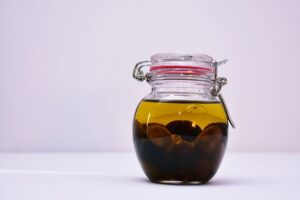
How Much Olive Oil For Weight Loss?
Pouring olive oil straight from the bottle is one of the quickest ways to undo...
Read More →Calculate your Total Daily Energy Expenditure using science-backed formulas. Get calorie targets for fat loss, maintenance, and muscle gain.
All calculations happen in your browser - we don't store any data
Fill in your information and click "Calculate My TDEE" to see your estimated daily calorie needs.
Understanding how we calculate your daily calorie needs
Total Daily Energy Expenditure (TDEE) represents the total number of calories your body burns in a 24-hour period. It consists of three main components:

Typical components of total daily energy expenditure shown for general illustration. Actual proportions vary between individuals.
We offer three scientifically validated formulas:
Most accurate for the general population. Default recommendation.
Men: (10×weight) + (6.25×height) - (5×age) + 5
Women: (10×weight) + (6.25×height) - (5×age) - 161Classic equation with improved accuracy from the 1919 original.
Uses lean body mass - ideal for athletes who know their body fat %.
BMR = 370 + (21.6 × Lean Body Mass in kg)Your BMR is multiplied by an activity factor based on your lifestyle:
| Activity Level | Multiplier | Description |
|---|---|---|
| Sedentary | 1.2 | Little or no exercise |
| Lightly Active | 1.375 | Light exercise 1-3 days/week |
| Moderately Active | 1.55 | Moderate exercise 3-5 days/week |
| Very Active | 1.725 | Hard exercise 6-7 days/week |
| Extremely Active | 1.9 | Very hard exercise & physical job |
Our calculator is based on peer-reviewed research and validated equations
Mifflin MD, St Jeor ST, Hill LA, Scott BJ, Daugherty SA, Koh YO. "A new predictive equation for resting energy expenditure in healthy individuals." American Journal of Clinical Nutrition. 1990;51(2):241-247.
PubMed: 2305711 ↗Roza AM, Shizgal HM. "The Harris Benedict equation reevaluated: resting energy requirements and the body cell mass." American Journal of Clinical Nutrition. 1984;40(1):168-182.
PubMed: 6741850 ↗McArdle WD, Katch FI, Katch VL. "Exercise Physiology: Nutrition, Energy, and Human Performance." 8th Edition. Lippincott Williams & Wilkins, 2014.
Standard textbook reference for exercise physiologyFrankenfield D, Roth-Yousey L, Compher C. "Comparison of predictive equations for resting metabolic rate in healthy nonobese and obese adults." Journal of the American Dietetic Association. 2005;105(5):775-789.
PubMen: 15883556 ↗FAO/WHO/UNU Expert Consultation. "Human energy requirements: Report of a Joint FAO/WHO/UNU Expert Consultation." Food and Agriculture Organization, 2004.
FAO Report ↗U.S. Department of Agriculture and U.S. Department of Health and Human Services. "Dietary Guidelines for Americans, 2020-2025." 9th Edition. December 2020.
DietaryGuidelines.gov ↗According to research published in the Journal of the American Dietetic Association, the Mifflin-St Jeor equation was found to be the most reliable for estimating BMR, predicting actual resting metabolic rate within 10% for more individuals than other equations tested. However, individual variation exists, and these calculations should be used as a starting point, adjusted based on real-world results.
BMR (Basal Metabolic Rate) is the number of calories your body burns at complete rest - just to keep you alive (breathing, circulation, cell production). It typically accounts for 60-70% of total calories burned.
TDEE (Total Daily Energy Expenditure) includes your BMR plus all additional calories burned through daily activities, exercise, and digesting food. TDEE is the number you should use for diet planning.
Our calculator uses the Mifflin-St Jeor equation, which research shows predicts actual metabolic rate within ±10% for most people. However, individual factors like genetics, hormones, body composition, and medical conditions can affect accuracy.
Recommendation: Use your calculated TDEE as a starting point. Track your weight for 2-4 weeks, then adjust calories up or down based on actual results.
For safe, sustainable weight loss:
Important: Never eat below your BMR for extended periods. Include protein (1.6-2.2g/kg) and resistance training to preserve muscle mass.
If unsure, stick with Mifflin-St Jeor - it's our default for good reason.
Recalculate your TDEE when:
No. All calculations happen entirely in your browser. We don't collect, store, or transmit any of your personal health information. Your privacy is fully protected.
Stay updated with nutrition and fitness insights
Pouring olive oil straight from the bottle is one of the quickest ways to undo...
Read More →
If you have scrolled through social media lately, you have probably seen claims that a...
Read More →
What Is 18-Hour Fasting, Really? Most people who try 18-hour fasting eat all their food...
Read More →
Is Goulash Healthy for Weight Loss Goulash is one of those comforting one-pot meals that...
Read More →
Understanding Water Weight and Diuretics Diuretics are substances that make your kidneys pull extra water...
Read More →
Most weight loss advice ignores the one thing that makes every diet easier: staying full....
Read More →
The Mediterranean diet keeps showing up in weight loss conversations for a reason. It is...
Read More →
You might think roasting nuts ruins them for weight loss, but the research tells a...
Read More →
Every few months, the same pattern repeats across Reddit’s weight loss communities. Someone posts a...
Read More →
Is What Order to Eat Food for Weight Loss the Real Answer? The order you...
Read More →
Why Quince Keeps Coming Up in Weight Loss Conversations Most fruit lists for weight loss...
Read More →
Thyroid Medication and Weight: What the Research Actually Shows Levothyroxine is one of the most...
Read More →
Is Soda Water Healthy for Weight Loss? Soda water is a smart swap when you...
Read More →
Most women I talk to have tried counting calories at some point, and most have...
Read More →
Is Tuna or Chicken Better for Weight Loss? The short answer is that both tuna...
Read More →This calculator provides estimates for informational and educational purposes only. It is not intended as medical advice, diagnosis, or treatment.
Individual metabolic rates vary based on factors including genetics, hormones, medications, and health conditions not captured by these calculations.
Always consult a qualified healthcare provider or registered dietitian before:
Last reviewed: September 2026